
The Resale Walk: How to Shop Antiques & Secondhand Like a Designer
Summer Edit Series: Antiques, Vintage, and Second hand Furniture — What to Look for, What to Skip, and How to Come Home with Something Fabulous

I love how this rustic farmhouse powder room came together with an antique workbench for a vanity and antique stained glass window remnant. A new, vintage inspired sink and corrugated steel wall help bring old and new together.
I'll be honest with you — some of my very favorite pieces in client homes didn't come from a showroom. They came from a barn in Stowe, a church sale in Woodstock, or from the Brimfield Antique Show. Secondhand shopping is one of the great joys of this work, and when you know what you're doing, it is absolutely the best way to bring soul into a space.
But it can also be overwhelming. You walk into a crowded estate sale at 7 a.m., you're slightly under-caffeinated, there are thirty people jostling around you, and suddenly you can't remember if you need a console table or a credenza or both. I've been there. Here's everything I've learned.
“If you’re standing there trying to convince yourself it works—it doesn’t.”
Antique, Vintage, or Just Old?
How to Know What You're Looking At When Buying Resale
Before we get into the shopping strategy, let's settle something that comes up constantly — even among people who've been doing this for years.
An antique is at least 100 years old.
That's the legal standard in the United States, established by the Smoot-Hawley Tariff Act of 1930 and upheld today by U.S. Customs regulations. It's not a loose guideline — it's the threshold used for customs classification, insurance appraisals, and import/export duty exemptions. As of 2026, that means anything made in 1926 or earlier qualifies.
Here's how the terminology actually breaks down:
Antique: 100+ years old, in original or largely original condition
Vintage: Roughly 20–99 years old — representing a specific era or design period (think Mid-Century Modern, Art Deco, 1970s bohemian)
Collectible: Valued for rarity or cultural significance regardless of age — a signed print, a limited-edition toy
Retro: A modern item styled to look old — no age requirement at all
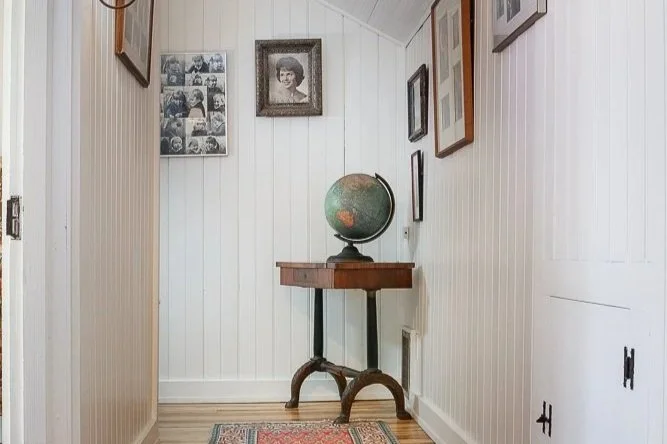
An antique school desk and globe look great in this hallway decorated with vintage family photos.
Why does this matter when you're shopping? Because the word "antique" gets used loosely everywhere — at flea markets, on Etsy, in estate sale listings. Knowing the difference helps you evaluate what you're actually paying for and whether the price makes sense.
How to Date an Antique
Resources and Clues to Look For
Dating a piece — figuring out when it was actually made — is one of the most satisfying skills you can develop as a shopper. You don't need to be an expert. You just need to know what to look for and where to look it up.
On the piece itself:
Maker's marks, stamps, labels, and signatures are the starting point. A single mark can narrow a piece to a specific manufacturer and decade.
Construction details tell you even more — hand-cut dovetail joints predate 1860; machine-cut dovetails came after.
Hand-forged iron hardware is generally pre-1830; cast brass butt hinges appeared around 1800.
The presence of wire nails (post-1880s) versus square-cut nails (pre-1880s) is a reliable signal.
Patina — the natural buildup of oxidation, handling, and age — is difficult to fake convincingly and one of the most honest indicators of genuine age.
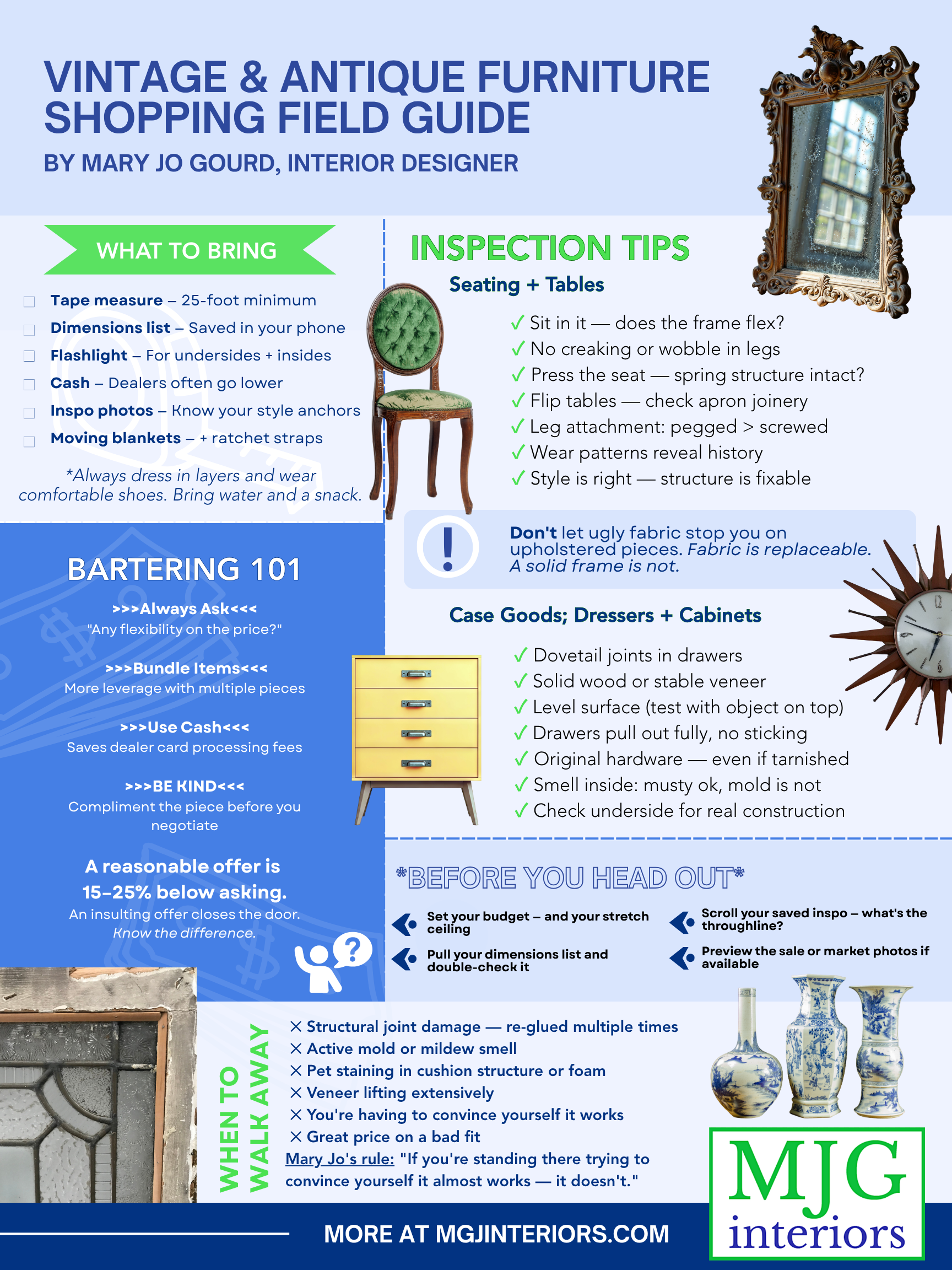
I love a good infographic! You can pin this on your own Pinterest board or download it for later.
Style periods to know for furniture:
Georgian (1714–1830): formal, symmetrical, mahogany and walnut
Victorian (1837–1901): ornate, carved, heavily upholstered — now solidly antique
Arts & Crafts (1895–1915): simple joinery, oak, handcrafted details — early pieces are antique
Art Nouveau (1890–1910): organic, flowing lines — most pieces now meet the 100-year mark
Art Deco (1920–1935): geometric, bold, lacquered — early pieces are just crossing into antique territory
Helpful resources for dating antiques:
Worthpoint — a massive database of sold antiques with marks and maker research tools
Kovels — long-running antiques reference with an extensive marks dictionary
Replacements, Ltd. — excellent for identifying china, pottery, and silver marks
NHADA (New Hampshire Antique Dealers Association) — great regional resource for New England antiques context
Antiqbot — a practical, detailed guide to dating furniture by construction clues
The Victoria and Albert Museum in London maintains reference collections for British makers and lock makers from 1700 onward — their online database is searchable and free
One important note: a single clue is rarely definitive. A piece might look Georgian but have machine-cut dovetails, which places it as a later revival — still beautiful and collectible, but not a period piece, and priced accordingly. Cross-reference everything you find. That's where the real detective work happens, and I think it's the most fun part of all!
Wondering why vintage and second hand is so popular these days? Check out my blog post about Why Everyone is Shopping Vintage Right Now.
Looking for more tips on how to barter, what to look for, and how to prepare? Check out my Guide to Antique Shows and Resale post.
MJG Interiors is a full-service interior design studio based in Vermont. We work with clients across New England on projects that balance livability, beauty, and a deep respect for the spaces we're working in. If you have questions about shopping or sourcing for your home, we'd love to hear from you.